
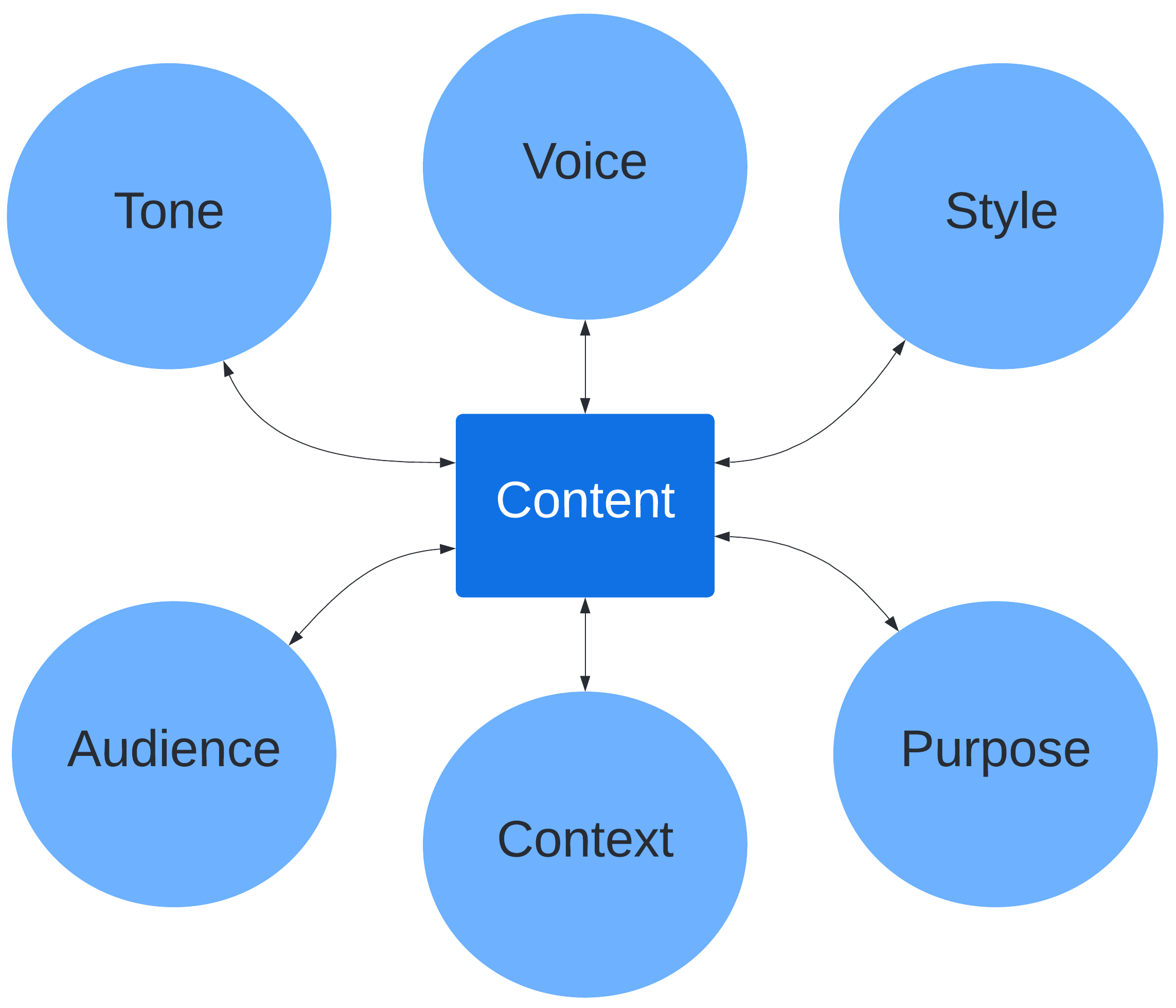
Content, or the topics that are written about in a text, is shaped by several rhetorical elements:
- Purpose: Why am I writing this?
- Audience: Who will read it?
- Context: How, when, where, why, and under what conditions will they read it?
- Style: How will I write this? What are the structure and cosmetics of my writing?
- Tone: What’s my stance on the topic? How do I feel about my audience?
- Voice: How do I want to present myself as a writer?
These rhetorical elements are based on the Rhetorical Situation or Rhetorical Triangle, which dates back to Aristotle. Any piece of writing can be characterized by using these elements: a product review, a text message, or the label on the back of a cereal box.
All six elements interplay, providing both definition and atmosphere to your writing (i.e., your content). Therefore, understanding and defining these elements can inform your writing choices. Furthermore, these elements serve as your compositional bedrock as you formulate, brainstorm, and outline your content.
The purpose, audience, and context of your writing are mostly external elements that frame your content; they overlap and influence each other significantly. However—voice, tone, and style are primarily internal elements over which you, as a writer, exert the most control; these internal elements can be modified and crafted based on the external elements and vice versa.
Content
Content, in a narrow sense, is the actual text and the topics addressed in a piece of writing.
What are you writing? What are your topics? What ideas do you want to express? What’s your evidence, data, or argument?
Once you decide the content you want or need to write, you can address the other elements more easily.
Purpose
The purpose is the goal or objective of the content.
What do you want your message to accomplish? Are you arguing about raising the voting age? Informing readers about a Facebook messenger scam? Persuading your audience to buy an air fryer? Or entertaining them with some satire? Perhaps your purpose is more devious, such as in a political campaign commercial or TikTok ad?
These questions set the stage for choosing your target audience and an appropriate tone, style, and context for presenting your content.
Asking yourself, “What’s my purpose in writing this?” paves the way for clarity—for both the audience and your composition efforts. And it’s a solid baseline to which you can return when you experience writer’s block, forget what you’re doing, or ramble and wander off-topic.
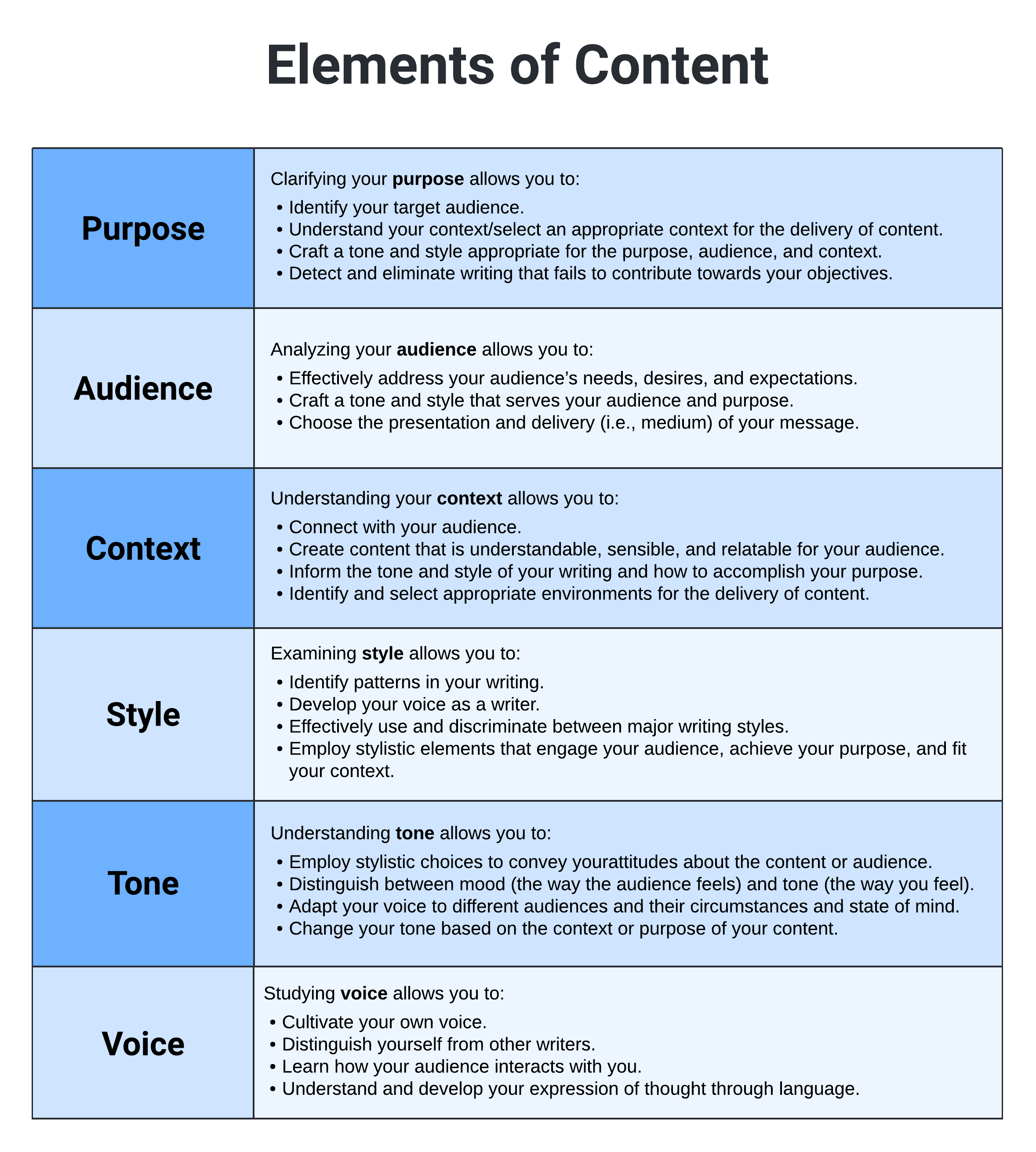
Clarifying your purpose allows you to:
- Identify your target audience.
- Understand your context/select an appropriate context for the delivery of content.
- Craft a tone and style appropriate for the purpose, audience, and context.
- Detect and eliminate writing that fails to contribute towards your objectives.
Audience
The audience includes potential readers, viewers, users, or consumers of the content.
Who will read your content? Why will they read it? What do they already know? What don’t they know? Why would they want to read it? What are their beliefs? What do they want? What do they care about? How’s your content going to benefit them? What are their expectations?
Consideration of your audience is (one of several components) critical to ensuring your message is interpreted and understood by your audience in a manner that serves your purpose. For example, if you’ve been assigned to write a definition of gravity and illustrate an example of it in a physics textbook, how would you modify your message to address each of the following audiences?
- Kindergartners
- Undergraduates enrolled in an introductory physics course
- Graduate students enrolled in an advanced physics course
- Physics professors or physicists
For the kindergarteners, you might use a more generic vocabulary, apply simple metaphors from the real world, explain the meaning of theory, and focus on a few key components that define gravity.
For the physics professors, you might use more technical vocabulary, apply complex examples, address advanced topics, such as anomalies in the theory of gravity, and contextualize gravity by summarizing alternative theories.
Elements to consider when defining, identifying, or understanding your audience:
- Demographics
- age, location, culture, gender, income, education, employment, social status, and political beliefs
- Connection or relationship between you and your audience
- Level of knowledge, experience, and familiarity with the topics addressed
- Their general disposition and potential reactions to your content
Analyzing your audience allows you to:
- Effectively address your audience’s needs, desires, and expectations.
- Craft a tone and style that serves your audience and purpose.
- Choose the presentation and delivery (i.e., medium) of your message.
Context
Context is a broad element that addresses the discourse and environment in which your content situates itself.
How will your audience read and react to your content? When will they read it, before or after the Black Friday sale? Where will they read it? Via a Facebook ad, an email, or a printed book—or via multiple avenues? How should you modify your content to fit the delivery method? Why would the audience want to read beyond the heading and the first few lines?
Your audience not only reads the content, but they are also often the ones who will criticize your content and contribute to its broader discourse.
The following question is crucial to understanding the effects your context will have on the reception of your content:
Under what conditions will your audience read the content?
What similar content has already been published? What’s the difference between your content and related content? In what social, financial, political, and cultural climate will your writing find itself? Whom does your audience regard as the authority on the topics you address? And who are the established professional and academic experts on the issue you are writing about? What are the counterarguments, competitors, and opponents to your content?
Understanding your context allows you to:
- Connect with your audience.
- Create content that is understandable, sensible, and relatable for your audience.
- Inform the tone and style of your writing and how to accomplish your purpose.
- Identify and select appropriate environments for the delivery of content.
Style
Style is how a writer puts words together to express their thoughts and ideas; it’s the cosmetics and structure of their writing.
Do you use technical jargon or simplistic vocabulary? What about imagery and metaphors? Do you use a lot of dashes? Are your sentences flowery and complex or simple and terse? Do you use subheadings? Are your paragraphs dense or sparse? Do you cite academic journal articles or nothing at all? Do you use emojis or use abbreviations? How do you present and transition ideas?
Elements that encompass style:
- Diction (word choice)
- Syntax (sentence structure)
- Semantics (connotations)
- Literary, rhetorical, and grammatical devices
- Flow, clarity, and pacing of your message
- Paragraph structure and transitions
- Use of evidence, argument, logic, and appeals (logos, ethos, pathos)
- Structure, organization, and arrangement of ideas
- Spelling, punctuation, and formatting
- Ambiguity, lucidity, coherence, and correctness
- Rhythm and cadence
Style, in a way, appears to be the most visible and concrete of the elements.
Examining style allows you to:
- Identify patterns in your writing.
- Develop your voice as a writer.
- Effectively use and discriminate between major writing styles (e.g., expository, technical, persuasive).
- Employ stylistic elements that engage your audience, achieve your purpose, and fit your context.
Tone
Tone is how a writer feels about the content or their audience.
What’s your intellectual or emotional stance on the content? What kind of words do you use to convey indignation? What adjectives or adverbs do you use in a letter to your mayor to express disapproval of the higher tax rate? Do you use technical jargon to impress your audience or generate a sense of credibility?
Mood and tone are not synonymous. Tone is how the writer feels, while mood is how the audience feels when they read a writer’s content. Mood is the atmosphere or ambiance created by a piece of writing, and it is effectively produced through a combination of narrative elements, voice, tone, and style.
Examples of tone:
- Formal or informal
- Humorous, comedic
- Nostalgic or avant-garde
- Ironic, sarcastic
- Cynical or optimistic
- Somber or whimsical
Let’s take an example: What sort of tone does a car manual employ? In all likeliness, a formal tone. What about a student who’s written an editorial piece on a tuition increase? Probably an indignant tone. And what about a letter from an old friend? Perhaps a nostalgic and sentimental tone.
A writer creates tone via their stylistic choices:
- Diction (word choice)
- Syntax (sentence structure)
- Literary, rhetorical, and grammatical devices
For example, you might use shorter words and sentences to convey a pithy and direct tone. Or you might use contractions, slang, and informal grammatical constructions to convey an informal and friendly tone.
A writer may modify or adapt their tone to appropriately suit their:
- Purpose
- Audience
- Context
Suppose you write an email to your boss about wanting a raise: You may feel you deserve a pay increase exceeding the standard annual raise because of your many accomplishments and new responsibilities. Therefore, you may want to employ an appreciative and professional tone, but you don’t want to express arrogance or self-righteousness. And this depends upon the types of words you use and how you use them; perhaps you directly and concisely note your accomplishments while initiating and concluding the email with optimistic and appreciative diction.
Understanding tone allows you to:
- Employ stylistic choices to convey your feelings or attitudes about the content or audience.
- Distinguish between mood (the way you want the audience to feel) and tone (the way you feel).
- Adapt your voice to different audiences and their circumstances and state of mind.
- Change your tone based on the context or purpose of your content.
Voice
Voice is the personality of a writer.
How do others view your writing? What’s unique about your way with words? What impression does your writing leave upon your audience?
Voice is your distinctive way of expressing yourself through language. It’s like your thumbprint as a writer—the way you look at the world, your unique sensibility, and how you distinguish yourself from other writers.
Voice is a combination of recurring stylistic choices, tones, moods, purposes, audiences, contexts, literary modes, genres, points of view, and subtextual elements.
It’s somewhat difficult to define, but it’s like when we have a word on the tip of our tongue or can’t quite define a scent that we love—it’s unique yet elusive. My favorite example is F. Scott Fitzgerald versus Ernest Hemingway: If you were to open the two books beside each other, I could easily distinguish between them, just by the words and sentences alone:
“Through all he said, even through his appalling sentimentality, I was reminded of something—an elusive rhythm, a fragment of lost words, that I had heard somewhere a long time ago.”
Fitzgerald, The Great Gatsby
“Downstairs we came out through the first-floor dining-room to the street. A waiter went for a taxi. It was hot and bright. Up the street was a little square with trees and grass where there were taxis parked.”
Hemingway, The Sun Also Rises
Fitzgerald is known for using more complex sentence structures and vivid descriptions, while Hemingway is known for shorter sentence structures packed with details.
Studying voice allows you to:
- Cultivate your own voice.
- Distinguish yourself from other writers.
- Learn how your audience interacts with you.
- Understand and develop your expression of thought through language.


I’d say impressive, remarkable…but you always are…your gift of articulation never ceases to amaze me!! Keep on,young man!!!
Sent from Yahoo Mail on Android
LikeLike
I love detailed contents. Like yours, Sweet whatever you are saying here can be used to the marekting and personal branding too. Thank you mate, I’m gonna use your content.
LikeLiked by 1 person