

Editing is often thought of as reparations for spelling atrocities and grammatical crimes. But it can be so much more than that. Your writing is so much more than its cosmetic blemishes.
Your writing is an expression of your personality (i.e., voice), emotions, and opinions—the subtext, the underlying symbolism, and unspoken words communicated save only through rhythm. It’s your tendency for terse, calculated sentences or flowery, complex ones—the manifestation of idiosyncratic em dashes—the cadence of your phrasing—the motifs of themes and imagery—and the tendency to kill lovable characters.
Editing is a process of refinement. You might add text, remove and reorganize paragraphs, and modify your word choice to better align with your audience or context. You might choose to change audiences, brainstorm better engagement tactics, revise your organization, adjust your purpose, or implement more ethos, pathos, or logos.
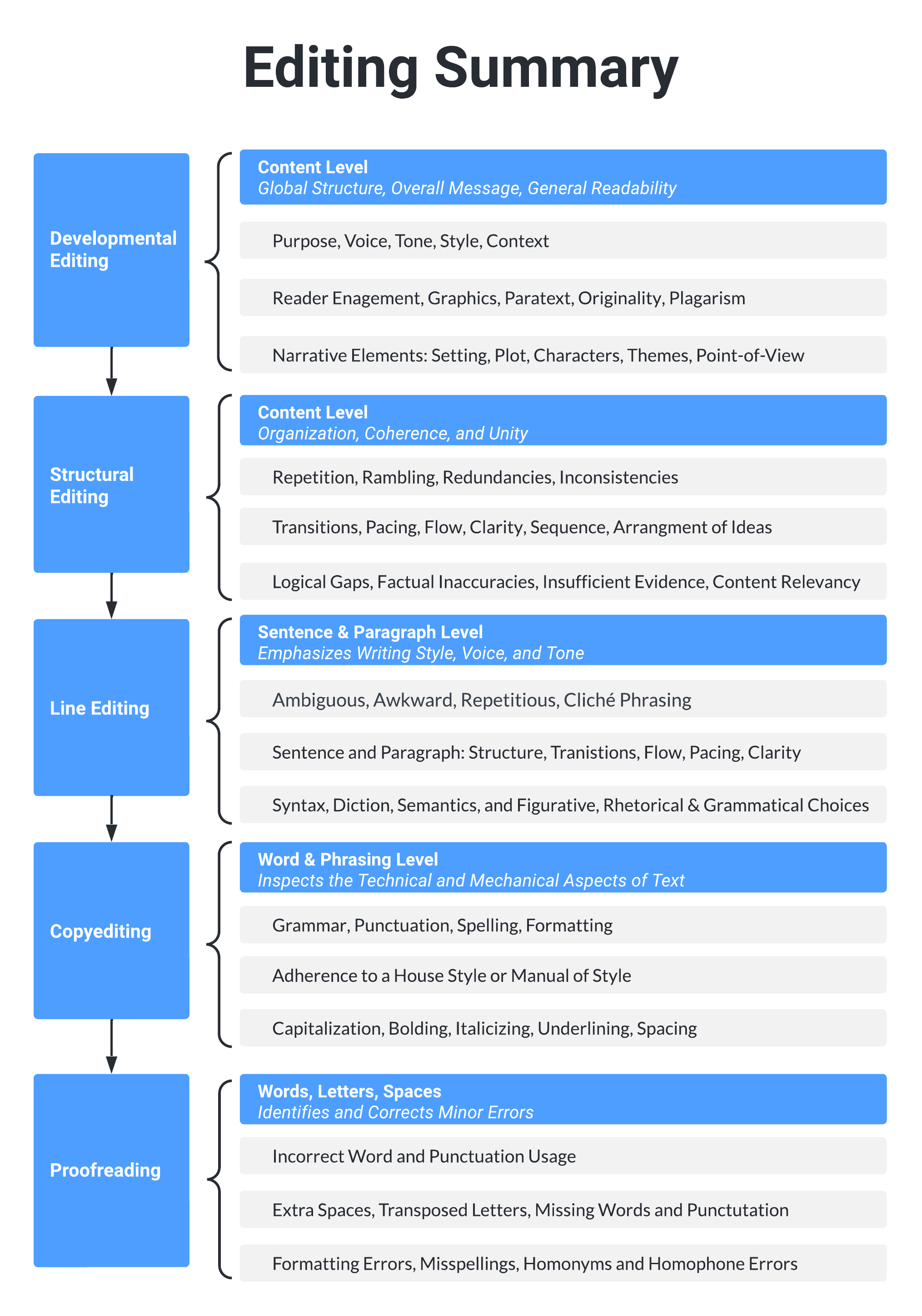
Every writer approaches editing differently. Some copyedit while they write, some jump back and forth between different kinds of editing while creating their initial draft, and some hand over the editing to that friend who loves to edit English papers. There is no right or wrong method. The below editing process is a recommended flow for refining any piece of text before you publish it into a blog post, post it on social media, or turn it into your history professor.
Each editing stage shares some overlap with the stage immediately before and after it. And notice, as you move through each stage, how the focus shifts from the overall draft to the paragraph level, then the sentence level, and finally to the word level.
Below are explanations of each type of editing.
Developmental Editing
This is the first stage of editing, which focuses on the general content and structure of a draft. Developmental editing is also known as Substantive Editing because the draft may be significantly rewritten and reorganized.
Higher-order concerns are addressed in this stage: the draft’s overall message, composition, readability, flow of ideas, audience engagement, and narrative elements like setting, plot, themes, and character development. Furthermore, this editing stage focuses on and clarifies the purpose, voice, tone, style, and audience of the draft—as well as the context or discourse in which the writing is situating itself.
Developmental editing is about the big picture issues; it’s more holistic and it aims to mature the draft before moving on to paragraph- and sentence-level concerns.
Structural Editing
Though structural editing is often integrated into the developmental editing stage, it can also be separated into its own stage.
Think of the synonyms for structure: arrangement, organization, and sequence. This editing is all about the order and systematic flow of the draft: the logical flow from topic to topic or event to event.
Structural editing attends to not only the order of larger sections of the draft, such as chapters or subsections, but also general paragraph consistency, arrangement, and flow.
This editing also identifies and remedies logical gaps in arguments or narration, the need for more evidence or clarification, and the elimination of redundancies, ramblings, and repetitions.
Line Editing
Line editing targets the syntax, semantics, and diction of the sentences in a draft. It ensures that the language aligns with your intended voice, tone, audience—and especially with the planned writing style (i.e., the cosmetics and structure of your sentences). Writing style includes many elements—such as rhythm, cadence, clarity, complexity, and length of your sentences, as well as punctuation and grammatical choices.
Line editing also examines the flow, consistency, and pacing of individual paragraphs, and it resolves issues of sentence fragments, run-on sentences, and ambiguous, repetitious, cliché, and awkward phrasings.
Though line editing is similar to copyediting, it tends to emphasize the style of writing rather than the technicalities of grammar, spelling, and punctuation.
Copyediting
Copyediting refines the draft at the word and phrasing levels. It inspects the more technical and mechanical aspects of the draft: grammar, spelling, capitalization, and punctuation errors. It also may involve formatting the draft or correcting formatting errors.
Additionally, this editing stage conforms the writing to fit the house style (e.g., AP, Chicago, or MLA). For example, different house styles, or manuals of style, have varying rules for using the oxford comma; formatting citations, footnotes, and endnotes; and capitalizing, italicizing, bolding, and underlining different kinds of text.
Proofreading
Proofreading is the final stage of editing a draft before its publication or transmission—an email, a speech, a cover letter, or a business report. It is the final phase of verifying, validating, and certifying that the draft is error-free. While it shares tasks with copyediting, like doublechecking errors at the word and phrase level, it also magnifies its lens to audit the letters and the spaces between them.
This type of editing clears the draft of minor mistakes that—if uncorrected—could create a negative impression for the reader: extra spaces between words, missing words and punctuation, incorrect word usage, and transposed letters.
Proofreading might also include formatting or reviewing the formatting of the draft to prepare it for publication in its final context.
 Dillon Bolding